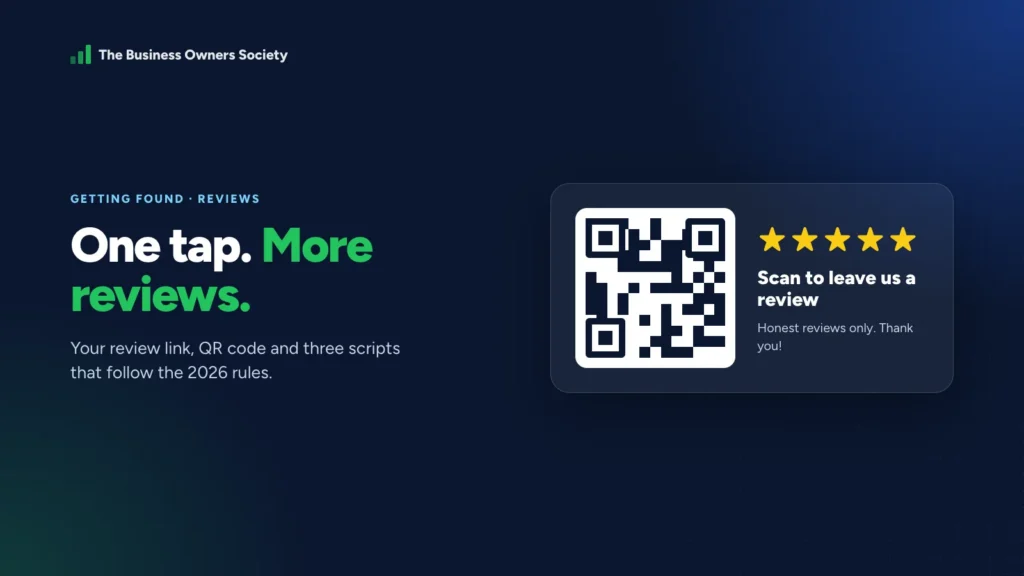
Nearly every customer who would happily review you never does, and it is almost always because nobody asked, or because asking took more than one tap.
So this is how to get more Google reviews properly in 2026: the exact route to your own review link and QR code, three scripts you can send today, when to ask, and — the part that has genuinely changed — the UK rules that now make the oldest review tactic in the book unlawful rather than merely cheeky.
Consumer figures: BrightLocal Local Consumer Review Survey, February 2026, 1,002 US adults. A US sample — the direction is not in doubt, the exact percentages are not British.
Why this is worth an hour of your week
Two reasons, and only one of them is the one people talk about.
The first is that reviews are one of only two things Google has publicly tied to your local ranking: “More reviews and positive ratings can help your business’s local ranking.” The other is your categories. Everything else in local SEO is inference. So this is not a nice-to-have, it is one of the two levers you are confirmed to have.
ChatGPT for Business Owners
50 copy-and-paste AI prompts for sales, marketing, customers, admin and money. Works with any AI tool.
The second is that reviews decide the click even when they do not decide the ranking. Nearly half of people will not use a business with fewer than 20 reviews, and only 9% will use one with five or fewer. Two thirds now want to see at least four stars, up from just over half the previous year. And three quarters only look at the last three months, which is the single most useful fact in this article: a review you earned two years ago is doing almost nothing for you today.
That last point reframes the whole job. This is not a one-off push to get to 50 reviews. It is a slow tap you leave running.
Get your review link and QR code
Google generates both for you. You do not need a third-party tool, and you should not use one that promises to filter reviews before they reach Google.
Open your profile on a computer
Go to business.google.com and find Read Reviews, then “Get more reviews”. The share icon gives you your link. The QR code can only be generated in a computer browser, not in the phone app — which is why most owners think it doesn’t exist.
Shorten it and save it somewhere you will actually find it
Not in your downloads folder. In your phone’s notes, in your invoicing software’s footer, and in a text shortcut so it is two taps from any conversation.
Print the QR code where the job finishes
On the back of the invoice, on the van door, on a card you hand over with the keys. The QR code exists so that the ask happens at the one moment the customer is pleased with you.
Check your review request before you send it
Paste in the message you were about to send. This looks for the three things that will get your reviews deleted, your profile labelled, or — new in the UK — the CMA interested in you.
The checker is not legal advice and it cannot see your intent. It catches the obvious, common mistakes — the ones that appear in almost every template being sold as “proven review scripts”.
What you must not do — Google’s rules and UK law
These overlap but they are not the same, and the UK half is new enough that most published advice predates it.
Google’s rules
| Practice | Status |
|---|---|
| Asking every customer for an honest review | Allowed, and Google says so |
| Sharing your review link or QR code | Allowed — Google provides both |
| Offering a discount, freebie or prize draw for a review | “Strictly prohibited” |
| Asking only the customers you expect to be happy | Prohibited — selective solicitation |
| Discouraging or burying negative reviews | Prohibited |
| Asking for a specific rating or specific wording | Prohibited |
| Pressuring a customer to review you while they are on your premises | Prohibited |
| Reviews from staff, former staff or contractors | Conflict of interest — removed |
| Paying someone, in cash or in kind, to review you | Fake engagement — account suspension territory |
And UK law, since 6 April 2025
Under the Digital Markets, Competition and Consumers Act 2024 it is now a banned practice to submit or commission a fake review, or a review that conceals the fact it was incentivised, and to publish reviews in a misleading way. There is also a positive duty: a trader must take “reasonable and proportionate steps” to prevent fake and concealed-incentive reviews and to remove them.
Trading Standards guidance names suppressing negative reviews and cherry-picking the good ones as examples of misleading review practice. So “only send the link to the customers who loved it” has moved from a grey-area tactic to something a regulator has written down as a problem. These banned practices are civil rather than criminal, and the CMA can require you to change and fine up to 10% of global turnover.
The enforcement you would actually feel, though, is Google’s. Under undertakings Google gave the CMA in January 2025, a business caught with fake reviews gets a warning label displayed on its profile next to the review score, has its ability to receive reviews switched off, and for repeat offences has every review deleted for six months or more. Years of genuine reviews, gone, because of a prize draw.
Allowed
- Asking every customer for an honest review
- Sharing your review link or QR code
- Reminding once, politely
- Replying to every review, good or bad
Not allowed
- Offering a discount, freebie or prize for a review
- Only asking customers you think are happy
- Writing, buying or swapping reviews
- Telling customers what to say or which rating to give
Three scripts that are compliant, and short
All three ask for an honest review, name no rating, offer nothing, and go to everyone. Swap in your own link.
Hi [name], thanks again for today. If you’ve got a spare minute, an honest Google review would really help us out: [link]. No worries either way.
Morning [name] — hope the [job] is still behaving itself. We’re a small team and reviews are how people find us, so if you’d be willing to leave an honest one it’d mean a lot: [link]. Thanks for having us.
Hi [name], your invoice is attached. One small favour: if you have a moment, we’d be grateful for an honest review of how the job went — it’s the main way new customers find us. It takes about a minute: [link]. Either way, thanks for the work, and give us a shout if anything needs looking at.
Three things those scripts do deliberately. They say honest rather than good. They give the customer an easy out, which raises replies rather than lowering them. And they go out to every single customer, which is both the compliant approach and the one that produces a believable spread of ratings.
When to ask
There is no UK survey on review timing, so treat this as judgement rather than data. What is not judgement is the three-month rule: since three quarters of people only look at recent reviews, the ask has to be routine, not seasonal.
| Moment | Why it works |
|---|---|
| As you finish, in person, with the QR code | Highest willingness, lowest friction, and you are standing there |
| Same evening, by text | They still remember the job and your name |
| With the invoice | They are already thinking about whether it was worth it — a double-edged moment, but an honest one |
| A week later, once | Catches the people who meant to and forgot. Once. Not a sequence. |
| Never: before the work is finished | You are asking them to rate something they cannot judge yet |
- 1As you finish
Ask in person
Show the QR code on your phone or the back of the invoice.
- 2Same day
Send the link
A short text or WhatsApp with your review link.
- 3A few days later
One reminder
Only if they have not left one. Then stop.
- ✓When it lands
Reply to it
In your own words, not a template.
Every customer, every job. The reason most businesses have few reviews is that nobody asked.
How many reviews do you actually need?
Enough to clear the threshold where people stop discounting you, then a steady trickle forever.
The consumer evidence says the cliff is around 20 — nearly half of people won’t use a business below that, and almost nobody will use one with five or fewer. Above that, more reviews keep helping, but each one helps less.
ChatGPT for Business Owners
50 copy-and-paste AI prompts for sales, marketing, customers, admin and money. Works with any AI tool.
On ranking specifically, the honest answer is that the evidence is thin. The best test anyone has published is a very small one: three businesses going from nine reviews to ten saw a small but noticeable lift in Maps, and going from ten to eleven did not repeat it. That is six businesses’ worth of data in total, with no control for what competitors were doing. Anybody quoting you a precise number of reviews needed to rank is making it up.
The number that matters more is the one nobody tracks: how many of your reviews are from the last ninety days. Count that one instead.
What about the bad ones?
Short version, because it deserves its own article: reply to it, once, calmly, in your own words, and move on. Do not argue, do not offer anything in exchange for taking it down — that is itself prohibited — and do not get a friend to post a counterweight.
Reply to the good ones too, and not with a template. Nearly nine in ten people expect owners to reply, and half say an obviously templated reply puts them off, which makes a copy-pasted “Thanks for your kind words!” worse than silence. Four in five expect a reply within a week.
Worth knowing: replying is a customer argument, not a ranking one. Google says replying “shows that you value their feedback” and makes no ranking claim, and the leading survey of local search practitioners ranks response rate 122nd out of 187 factors. Do it because it wins work.
Your two jobs this week
1. Get the link and the QR code, on a computer, today.
Ten minutes. business.google.com, Read Reviews, Get more reviews, share icon. Then put the link in your phone as a text shortcut and the QR code on the back of your invoice. The reason you have not got more reviews is almost never willingness — it is that the ask is three taps too far away.
2. Ask your last ten customers. All ten.
Not the five you think liked you. All ten, same message, from the scripts above. That is the compliant way and it is also the way you find out something useful about your business.
Reviews are one of the twelve moves we work through with members in order, with somebody checking you did them. If that is the part that keeps slipping, you can start for £1. If you would rather see where you currently show up on the map first, the free map scan is free and takes a minute.
And if you want the wider picture of what actually moves your position in Maps — reviews are only one of the two confirmed factors — the 2026 Google Maps checklist covers the rest, including the seven tactics that have been tested and do nothing.
Review questions owners ask
How do I get more Google reviews?
Ask every customer, at the moment the job finishes, with a link or QR code that takes one tap. Google generates both for you at business.google.com under Read Reviews, then “Get more reviews” — though the QR code can only be created on a computer, not in the phone app. Then keep asking, permanently, because three quarters of people only look at reviews from the last three months.
Can I offer a discount or a prize draw for a Google review?
No. Google calls offering incentives for reviews “strictly prohibited”, and since 6 April 2025 a review that conceals the fact it was incentivised is a banned practice in UK law under the DMCC Act, enforceable by the CMA with fines of up to 10% of global turnover. Even a disclosed incentive still breaches Google’s rules and risks your reviews being deleted and your profile labelled.
Can I just ask the customers I know are happy?
No. Google prohibits selectively soliciting positive reviews and discouraging negative ones. And UK Trading Standards guidance gives cherry-picking positive reviews and suppressing negative ones as examples of publishing reviews in a misleading way. Ask everyone, with the same message. A spread of ratings is also more convincing to customers than a wall of fives.
How many Google reviews do I need?
For customers, about 20 is the threshold where people stop discounting you — nearly half won’t use a business below it. For ranking, nobody honestly knows: the only published test covers six businesses and found a small lift going from nine reviews to ten that did not repeat at eleven. The more useful target is how many of your reviews are from the last ninety days.
Should I reply to every review?
Yes, and not with a template. Nearly nine in ten people expect owners to reply, four in five expect it within a week, and half say an obviously templated reply puts them off — so a copy-pasted thank-you is worse than nothing. Do it to win customers rather than to move your ranking: Google makes no ranking claim about replies, and practitioners rank response rate 122nd of 187 factors.
Can I ask my staff to leave a review?
No. Google treats reviews from anyone with current or former employment, or a contractual relationship with you, as a conflict of interest and removes them. Google’s policy was also tightened to prohibit asking staff to solicit a set number of reviews or reviews mentioning particular staff names.
Can I get a bad review removed?
Sometimes, if it breaches Google’s content policies — it is fake, it is from a competitor, it contains abuse, or it is about a different business. An honest bad review about a real experience will not be removed, and asking the customer to take it down in exchange for anything is itself prohibited. Reply once, calmly, and let the recent genuine reviews outweigh it.
Checked on 9 October 2026 against Google’s own guidance on getting reviews, creating a review link and QR code, and prohibited and restricted content for Maps contributions; the CMA’s unfair commercial practices guidance (CMA207, 18 November 2025) on banned practice 13 of Schedule 20 to the DMCC Act 2024, in force 6 April 2025; the Trading Standards-backed Business Companion guidance on online reviews and endorsements (updated October 2025); and the CMA’s January 2025 announcement of undertakings from Google. Consumer statistics are from BrightLocal’s Local Consumer Review Survey of 11 February 2026, a survey of 1,002 US adults. Ranking-effect claims rest on small published tests and are described as such in the text. This is general information, not legal advice.
ChatGPT for Business Owners
50 copy-and-paste AI prompts for sales, marketing, customers, admin and money. Works with any AI tool.
Primary sources: getting reviews on Google · creating a review link or QR code · prohibited and restricted content · improving your local ranking · CMA undertakings from Google on fake reviews · Business Companion on online reviews and endorsements.

James Nicholson
Founder of The Business Owners Society and Digital Marketing Desk. Built a £2m business from his bedroom, lost it, and spent the next fifteen years helping 150+ UK businesses get found.
More about James →