Ask ten electricians what they charge and you will get ten numbers, most of them borrowed from whoever quoted the same job last month.
ChatGPT for Business Owners
50 copy-and-paste AI prompts for sales, marketing, customers, admin and money. Works with any AI tool.
This is the electrician hourly rate UK question answered properly: what the published guides say in 2026, what the official pay figures actually measure, and a calculator that works out your rate from your own costs instead of from your competitors’ nerve.
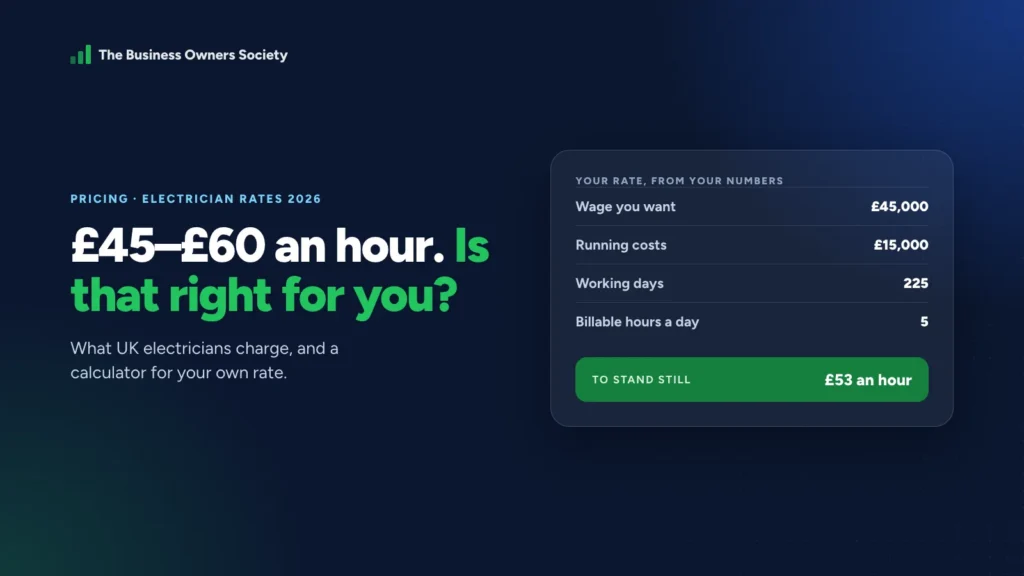
The short version: the main guides put UK electricians at £45 to £60 an hour, around £50 on average, and about £400 for a full day. Whether that is right for you comes down to three numbers most electricians have never written down.
What do electricians charge per hour in the UK in 2026?
Most UK electricians charge between £45 and £60 an hour in 2026, with £50 the typical figure, according to Checkatrade’s electrician cost guide (last updated May 2026). A day rate works out at around £400. Emergency and out-of-hours work is usually £80 to £100 an hour, and many electricians charge a minimum call-out that covers travel and the first hour.
Rates vary a lot by city. This table is Jobbit Pro’s estimate, built from the national guides with regional adjustments, so treat it as a sense-check rather than gospel:
| City | Typical hourly range |
|---|---|
| London | £65–£110 |
| Brighton | £55–£95 |
| Bristol, Edinburgh | £50–£85 |
| Manchester, Birmingham, Leeds, Glasgow, Nottingham | £50–£80 |
| Sheffield, Liverpool | £45–£75 |
| Cardiff, Belfast | £45–£72 |
| Newcastle | £45–£70 |
Labour only, excluding materials, VAT and parking. Jobbit Pro, “Trade rates by UK city in 2026”, September 2026, derived from Checkatrade, MyBuilder and other 2026 rate guides.
The official figure is a wage, not a rate
The Office for National Statistics measures what employed electricians are paid. For 2025, the median for electricians and electrical fitters (around 97,000 jobs) was £39,187 a year. The middle half earned between about £30,900 and £48,400.
That is a wage. It deliberately leaves out the self-employed. The difference between an employed electrician’s pay and a £50 charge-out rate is not profit. It is the cost of being the business: the van, the insurance, the scheme membership, the test equipment, and every hour you spend quoting, travelling and chasing payment that nobody pays you for.
The gap pays for the van, insurance, scheme fees, tools, and every unbilled hour. It is not profit.
£39,187 ÷ (40 hours × 52 weeks) ≈ £18.84 an hour. A rough conversion for comparison only.
What your hourly rate has to cover
Before the calculator, list what the business actually costs you in a year. Most electricians underestimate this by leaving out the items that come round once a year or every few years. Tick off what you have already counted:
0 of 9 counted.
Add them up and put the total into the calculator as your running costs. If you have never done this, expect the number to be bigger than you thought.
ChatGPT for Business Owners
50 copy-and-paste AI prompts for sales, marketing, customers, admin and money. Works with any AI tool.
Work out your own electrician hourly rate
Four numbers. What you want to earn before tax, what the business costs you to run for a year, how many days you will actually work, and how many hours of each day you can genuinely put on an invoice.
£53an hour, to stand still
£267a day at that rate
At £50 an hour you would be about £3,750 a year short of what you asked for.
Read the answer as a floor. It is the rate at which you earn exactly what you asked for and not a penny more. Every job you quote below it is a job you are partly paying for yourself.
Billable hours: where most rates go wrong
Nobody bills eight hours a day. You drive between jobs, you go and look at work that never turns into a booking, you write quotes in the evening and you spend Friday afternoon at the wholesaler. A recent survey of UK tradespeople found they spend over five hours a week on admin alone, before any travel.
On the tools 5hTravel 1.5hQuotes 1hAdmin 30m
Only the green part goes on an invoice. Price as if that is all the time you have, because it is.
Here is what that does to the rate. Same wage, same costs, only the billable hours change:
If you have been pricing as if you bill eight hours and you really bill five, you have been undercharging by about £20 an hour without ever deciding to.
Hourly or fixed price?
Most domestic customers would rather have a fixed price, and most electrical work suits one. The hourly rate is still the foundation: it is what you build every fixed price from.
| Charge by the hour for | Quote a fixed price for |
|---|---|
| Fault finding, where you cannot know how long it will take | Socket and light additions, consumer unit changes |
| Small odd jobs and call-outs | Rewires, once you have surveyed the property |
| Work where the customer keeps changing their mind | EICRs and landlord certificates |
| Emergency and out-of-hours work | EV charger and similar packaged installs |
For fixed prices, estimate the hours honestly, multiply by your rate from the calculator, add materials with a markup, and round up. If you are not sure of the difference between markup and margin, that has its own guide, because getting it wrong quietly wipes out your profit.
How to tell customers your rate
Customers rarely object to a rate that is explained in one sentence. They object to surprises. Put your rate and what it includes in writing before you start, and say it plainly:
“It’s £[rate] an hour, or I’ll give you a fixed price once I’ve seen the job. That includes [testing and certification / clearing up / a guarantee on the work]. Materials are on top at cost plus a handling charge, and I’ll list them on the quote.”
If a customer says another electrician is cheaper, that may well be true. The answer is not to match it; it is to say what your price includes that theirs may not, and let them decide.
Emergency, out-of-hours and call-out charges
Checkatrade puts emergency electricians at around £90 an hour, with urgent call-outs at £80 to £100. Many charge a minimum call-out that covers travel, the first hour on site and initial fault finding.
- Set your out-of-hours rate as a multiple, not a guess. One and a half to two times your day rate is common, and it is easy to explain.
- Say what the call-out includes. “£X covers travel, the first hour and finding the fault” stops the argument before it starts.
- Put it in writing before you set off. A two-line text with the price is enough, and it is fair on the customer.
The £90,000 line
Once your turnover passes the VAT registration threshold of £90,000 in any rolling 12 months, you have to register and add VAT to your prices. For domestic customers, who cannot reclaim it, that is effectively a 20% price rise overnight. Watch your rolling total, not just your tax year, and plan your pricing before you reach the line rather than after.
ChatGPT for Business Owners
50 copy-and-paste AI prompts for sales, marketing, customers, admin and money. Works with any AI tool.
Your two jobs this week
Job 1: Run your number
Put your real costs and your honest billable hours into the calculator above. Write down the hourly rate it gives you. That is your floor.
Job 2: Update one price
Pick the job you quote most often, rework its fixed price from your new rate, and use it on the next quote. If you are well below your floor, read how to put your prices up without losing customers.
Members of the Society get jobs like these every week, with the tools to do them and somebody checking they got done. Start for £1 if you want somebody keeping count.
Electrician rate questions owners ask
How much does an electrician charge per hour in the UK?
Most charge £45 to £60 an hour in 2026, about £50 on average, according to Checkatrade’s May 2026 guide. London and the South East are higher; city estimates put London at £65 to £110.
What is a typical electrician day rate?
Around £400 for a full day at £50 an hour. Your own day rate should come from your costs and billable hours, which the calculator above works out.
How much do electricians charge for emergency call-outs?
Usually £80 to £100 an hour, often with a minimum call-out that covers travel and the first hour.
Should electricians charge hourly or a fixed price?
Fixed price for defined work like consumer unit changes, rewires and certificates; hourly for fault finding and open-ended jobs. Build both from the same hourly rate.
Why is my hourly rate higher than an employed electrician’s wage?
Because a wage leaves out everything the employer pays for: the van, insurance, tools, scheme fees, holidays and unbilled time. Your rate has to cover all of it.
Sources: Checkatrade electrician hourly rate guide (May 2026); Jobbit Pro trade rates by UK city (September 2026); ONS Annual Survey of Hours and Earnings 2025, SOC 5241. Figures are guides; your rate should come from your own costs.

James Nicholson
Founder of The Business Owners Society and Digital Marketing Desk. Built a £2m business from his bedroom, lost it, and spent the next fifteen years helping 150+ UK businesses get found.
More about James →