Here is a number that stops most owners in their tracks.
ChatGPT for Business Owners
50 copy-and-paste AI prompts for sales, marketing, customers, admin and money. Works with any AI tool.
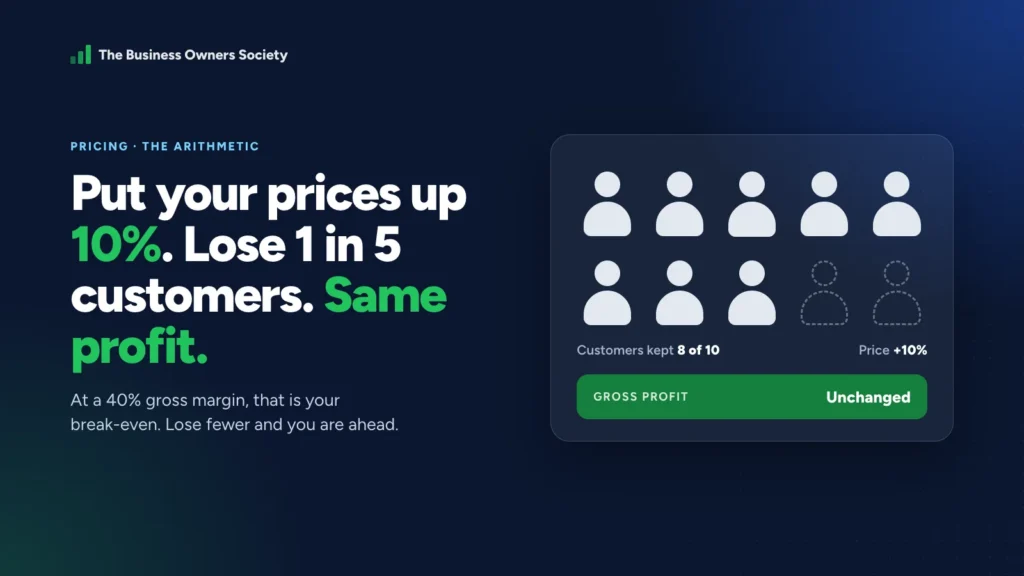
If your gross margin is 40% and you put your prices up by 10%, you could lose one in five of your customers and still make exactly the same gross profit.
Not similar. The same. And if you lose fewer than one in five, which is what usually happens, you are better off and doing less work for it.
This guide gives you the arithmetic, a calculator to run your own numbers, the exact words to send new and existing customers, what to say to the people who push back, and a 45-day plan to get it done. Put the kettle on; it is worth twenty minutes.
The arithmetic: how many customers can you afford to lose?
The percentage of customers you can lose after a price rise, and still make the same gross profit, is the rise divided by your margin plus the rise. At a 40% margin and a 10% rise, that is 10 ÷ (40 + 10) = 20%. Your margin here means gross margin: turnover minus the direct cost of doing the work, as a percentage of turnover.
Put your own numbers in. Nothing is saved or sent anywhere.
20%of your customers you could lose and make exactly the same gross profit
£15,000extra gross profit a year if you lose none
Lose 10% of customers, half your break-even, and you still keep about £7,500 more gross profit a year, with less work to do.
The table below does the same sum across the margins most small businesses run at. Find your margin down the side and your rise along the top. The number is the share of customers you would have to lose before the rise cost you anything.
| Gross margin | +5% rise | +10% rise | +15% rise | +20% rise |
|---|---|---|---|---|
| 20% (resale, materials-heavy) | 20% | 33% | 43% | 50% |
| 30% | 14% | 25% | 33% | 40% |
| 40% (typical trade) | 11% | 20% | 27% | 33% |
| 50% | 9% | 17% | 23% | 29% |
| 60% (labour-led, services) | 8% | 14% | 20% | 25% |
Two things jump out. The lower your margin, the more customers you can afford to lose, because every pound of the rise is a bigger share of what you keep. And even at a 60% margin, a 10% rise survives losing one customer in seven. Very few businesses lose that many.
100 jobs at £100
| Turnover | £10,000 |
| Direct costs (100 × £60) | £6,000 |
| Gross profit | £4,000 |
80 jobs at £110
| Turnover | £8,800 |
| Direct costs (80 × £60) | £4,800 |
| Gross profit | £4,000 |
Lose fewer than 20 and you are better off, with fewer hours worked.
Why the number is always higher than people expect
Because a price rise costs you nothing to deliver. No extra materials, no extra hours, no extra diesel. Every penny lands straight on your gross profit. That is why it is the single most powerful lever in a small business, and the one that gets left alone the longest.
Compare it with the alternative. To add £15,000 of gross profit at a 40% margin by winning more work, you need £37,500 of new turnover: more enquiries, more quotes, more evenings, more van miles. The price rise gets you there with the customers you already have.
Why 2026 is the year to stop putting it off
Your costs did not wait for you. The National Living Wage went up from £12.21 to £12.71 an hour in April 2026, a 4.1% rise, on top of a 6.7% rise the year before (gov.uk rates). Employer National Insurance went up in April 2025. The Federation of Small Businesses estimated that a firm with nine staff on the living wage would see its employment bill rise by about £25,850 between January 2025 and April 2026.
Meanwhile your rent went up, your insurance went up, your materials certainly went up. If your price list is the one you wrote in 2023 or 2024, you have not held your prices. You have cut them, a little every month, and paid for the cut yourself.
ChatGPT for Business Owners
50 copy-and-paste AI prompts for sales, marketing, customers, admin and money. Works with any AI tool.
Seven signs your prices are too low
Tick the ones that are true. Three or more and this is the most valuable job on your list this month.
0 of 7 ticked.
A win rate above 70% deserves a special mention. It is not a sign you are good at sales. It is usually a sign you are the cheapest sensible option, and customers can tell.
How much should you put your prices up?
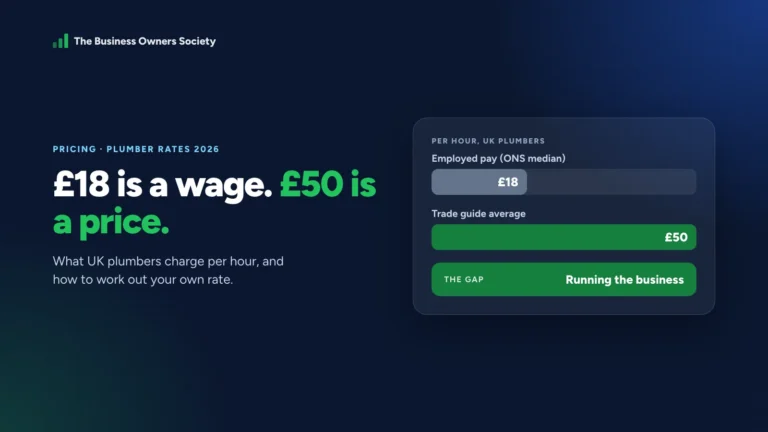
Before you pick a percentage, it is worth knowing whether the price you are raising was ever right in the first place. For trades, what a plumber should charge per hour works that out from your costs and your real billable hours, and the method applies whatever your trade.
There is no universal answer, but there is a sensible way to choose:
Catching up with costs
If you raised prices in the last year and just need to keep pace. Easy to explain, and almost nobody notices.
The default for most owners
If you have held prices for two years or more. Covers the cost rises since and starts to rebuild your margin.
Repositioning
If you win nearly every quote, are booked solid, or are clearly below the going rate. Do it for new customers first and watch the win rate.
Whatever you choose, use the calculator above to see your break-even before you commit. If the break-even loss is far above anything you could realistically lose, you have room to go higher.
How to put your prices up, step by step
- 1Day 1
New enquiries pay the new price
No announcement. The new price is simply the price on every quote from today.
- 2Day 14
Check the win rate
Count quotes sent and won against the fortnight before. That is your evidence.
- 3Day 15
Give existing customers 30 days
One short message, in writing, with a date and one honest reason.
- ✓Day 45
Every invoice at the new rate
Answer the two who push back with a smaller scope, never a discount.
Check your contracts first: fixed-price agreements run to their end date.
1. New enquiries pay the new price, from today
Not by email, and not to everyone at once. Start with new enquiries only. Nobody has to be told anything: the new price is simply the price on every quote you send from now on. Update your quote template, your price list and your website the same afternoon so nothing contradicts it.
If someone asks, the honest answer is the whole answer:
“That’s our current rate for this kind of job. It includes [what makes yours better: the guarantee, the clean-up, the named engineer]. Happy to walk you through what’s in it.”
2. After a fortnight, check your win rate
Count the quotes you sent and the quotes you won in the two weeks since, and compare with the two weeks before. If the win rate barely moved, you have your evidence that the market will take it, and the confidence to do step three. If it dropped sharply, look at what kind of jobs you lost before deciding anything.
3. Existing customers get 30 days’ notice and one reason
Thirty days, in writing, with a date and one honest sentence about why. Not an apology and not a paragraph of justification, because both invite negotiation.
Subject: Our prices from 1 [Month]
Hi [Name],
A quick note to let you know that from 1 [Month] our rate for [service] goes to £[X]. Costs have risen across the board and we have held our prices since [year].
Anything booked before then stays at the current price. Thank you for your custom; we really do appreciate it.
[Your name]
Hi [Name], it’s [you] from [business]. Just a heads-up that our rate for [service] moves to £[X] from 1 [Month]. Anything booked before then stays at today’s price. Thanks as always.
Notice the line about booking before the date. It is fair, it rewards loyalty, and it often pulls work forward into the next month, which is a pleasant side effect.
4. Have an answer ready for the two who push back
Because two will, and if you have not thought about it you will fold. The answer is not a discount. It is usually a smaller scope at the old price, which lets them keep their budget and lets you keep your rate.
| What they say | What you say |
|---|---|
| “That’s a big jump.” | “It is the first change since [year]. If the budget is fixed, we can look at doing [smaller scope] for the same money as before.” |
| “[Competitor] is cheaper.” | “They may well be. If price is the main thing, they could be a good fit. If [your difference] matters, that’s what you’re paying for.” |
| “Can you hold it for me?” | “Anything you book before [date] is at today’s price. After that it’s the new rate for everyone.” |
| “I’ve been with you for years.” | “You have, and that’s why you’re hearing it from me a month early. The early booking window is my way of saying thank you.” |
Mistakes that turn a good price rise into a bad week
- Apologising. “Sorry, but we have to…” tells the customer it is negotiable. State it, give the reason, move on.
- Over-explaining. Three paragraphs about energy prices reads as guilt. One sentence is enough.
- Doing it by group email with everyone copied in. Send it individually, or use a mail tool that does it for you.
- Raising prices on fixed-price contracts mid-term. If you agreed a price for a period, honour it and apply the new rate at renewal.
- Making it a one-off. Put a review in your diary for the same month every year, so it becomes routine rather than a crisis every four years.
What actually happens after you do it
Almost always less than you fear. A handful of grumbles, one or two people who drift, and a business that is measurably better off for the same work. The customers who leave over ten percent were rarely the ones you wanted.
A fair caveat: if you sell something identical to the shop next door, where buyers compare on price alone, your break-even maths still holds but you will feel losses faster. The answer there is usually to make the offer less identical (a guarantee, speed, a package) rather than to stay cheap.
The hard part was never the arithmetic. It was being the person who sends the email, which is exactly the kind of thing that does not happen unless somebody is expecting you to do it.
ChatGPT for Business Owners
50 copy-and-paste AI prompts for sales, marketing, customers, admin and money. Works with any AI tool.
Your two jobs this week
Job 1: Run your number
Put your turnover and margin into the calculator above and write down your break-even loss for a 10% rise. That is the most customers you could lose before it cost you anything.
Job 2: Change your quote template
Update the price on every quote, price list and web page today. New enquiries pay the new price from tomorrow. Diary a reminder for 14 days’ time to check your win rate.
Members of the Society get jobs like these every week, with the tools to do them and somebody checking they got done. Start for £1 if you want somebody keeping count.
Price rise questions owners ask
How much notice should I give customers before a price increase?
Thirty days in writing is a sensible default for regular customers. For anyone on a fixed-price agreement or contract, check its terms: you usually have to honour the agreed price until it ends, and some contracts set out a notice period of their own.
Should I tell new customers that my prices have gone up?
No. New customers have no old price to compare with. The new price is simply your price. Only existing customers need notice.
How do I work out my gross margin?
Take your turnover, subtract the direct costs of doing the work (materials, parts, stock, subcontractors), and divide what is left by your turnover. Overheads like rent, insurance and your own wages do not count here.
Is it better to put prices up a little every year or a lot at once?
A little every year. Small, regular rises in line with costs are easier for customers to accept and stop your margin quietly shrinking in between. A big catch-up rise is fine if you are years behind; just do new customers first.
What if I lose my biggest customer?
Run the calculator with that customer’s share of your turnover in mind before you send anything. If losing them would hurt more than the rise helps, talk to them individually first, and consider a smaller rise or a longer notice period for that one account.
Figures for illustration. This is general guidance, not financial or legal advice; check any written contracts before changing prices for existing customers.

James Nicholson
Founder of The Business Owners Society and Digital Marketing Desk. Built a £2m business from his bedroom, lost it, and spent the next fifteen years helping 150+ UK businesses get found.
More about James →