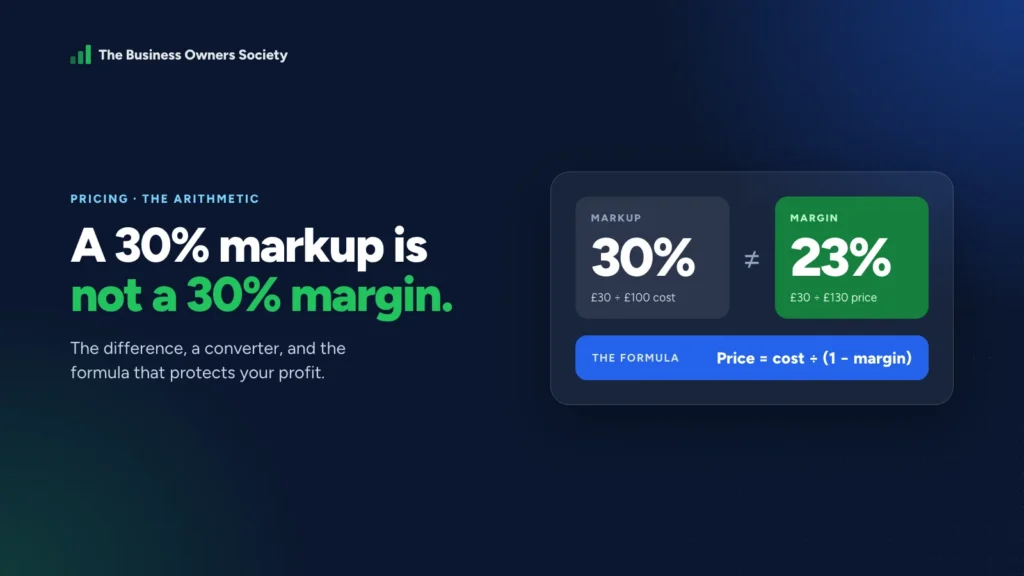
A 30% markup is not a 30% margin. It is a 23% margin.
ChatGPT for Business Owners
50 copy-and-paste AI prompts for sales, marketing, customers, admin and money. Works with any AI tool.
That seven-point gap sounds like accountant’s pedantry until you realise it is the difference between the profit you think you are making and the profit you actually make. Owners who set prices with a markup and judge them against a margin target end up short on every single job, and never quite work out why.
This guide explains markup vs margin in plain English, gives you a converter that does the sum both ways, a table you can pin above your desk, and a price-finder that tells you what to charge to hit the margin you want.
What is the difference between markup and margin?
Markup is profit as a percentage of what something cost you. Margin is profit as a percentage of what you sold it for. Both use the same profit in pounds; they just divide it by a different number. Because the selling price is always bigger than the cost, the margin percentage is always smaller than the markup percentage.
£30 ÷ £100
| Cost | £100 |
| Profit | £30 |
| Markup | 30% |
£30 ÷ £130
| Price | £130 |
| Profit | £30 |
| Margin | 23.1% |
Your accountant, your bank and your profit and loss report all talk in margin. Most price lists are built with markup.
Markup and margin converter
Type in either number and the other one updates. Add a cost to see the price and profit in pounds.
£130selling price
£30profit on each one
A 30% markup is a 23.1% margin.
The markup to margin table
Find the margin you want in the left column. The middle column is the markup that gets you there. Pin it up next to wherever you price jobs.
| Margin you want | Markup you need | £100 cost sells for |
|---|---|---|
| 10% | 11.1% | £111.11 |
| 15% | 17.6% | £117.65 |
| 20% | 25% | £125.00 |
| 25% | 33.3% | £133.33 |
| 30% | 42.9% | £142.86 |
| 35% | 53.8% | £153.85 |
| 40% | 66.7% | £166.67 |
| 50% | 100% | £200.00 |
| 60% | 150% | £250.00 |
At a 20% margin the two are five points apart. At 50% they are fifty points apart. That is where the expensive mistakes live.
The formulas, if you want to do it yourself
Margin from markup
Margin = markup ÷ (1 + markup). A 50% markup: 0.5 ÷ 1.5 = 33.3% margin.
Markup from margin
Markup = margin ÷ (1 − margin). A 40% margin: 0.4 ÷ 0.6 = 66.7% markup.
Price for a target margin
Price = cost ÷ (1 − margin). £240 of materials at a 35% margin: £240 ÷ 0.65 = £369.23.
The third one is the one to remember. If you know what something costs and the margin you need, it gives you the price directly, with no conversion step to get wrong.
Three worked examples
A heating engineer supplying a boiler
The boiler costs £1,200 trade. They want a 20% margin on parts. Price = £1,200 ÷ 0.80 = £1,500. Adding 20% would have given £1,440 and a 16.7% margin, £60 short on every boiler.
A gift shop pricing a candle
The candle costs £6. The shop needs a 55% margin to cover rent and staff. Price = £6 ÷ 0.45 = £13.33, so it goes on the shelf at £13.50. That is a 125% markup.
A builder passing on a subcontractor
The plasterer quotes £800. The builder wants a 15% margin for organising and guaranteeing the work. Price = £800 ÷ 0.85 = £941.18. Adding 15% would give £920 and only a 13% margin.
In every case the margin formula gives a slightly higher price than “adding the percentage”. On a single job the difference looks small. Across a year of jobs, it is often the whole of your profit.
The mistake that costs the most
It usually goes like this. You know your business needs a 40% gross margin to cover overheads and pay you properly. So you add 40% to your costs. A £1,000 job becomes £1,400.
But £400 profit on a £1,400 price is a 28.6% margin, not 40%. On £100,000 of costs a year, that is the difference between £40,000 of gross profit you were counting on and the £66,667 you actually needed to charge for. Same work, same customers, about £26,700 a year missing.
£1,400
| Cost | £1,000 |
| Profit | £400 |
| Margin | 28.6% |
£1,666.67
| Cost | £1,000 |
| Profit | £666.67 |
| Margin | 40% |
The fix is not to work harder. It is to use the right formula: price = cost ÷ (1 − margin).
It works the other way too. If a supplier tells you they “only make 20%”, ask which 20%. A 20% margin is a 25% markup; a 20% markup is a 16.7% margin.
ChatGPT for Business Owners
50 copy-and-paste AI prompts for sales, marketing, customers, admin and money. Works with any AI tool.
Which should a small business use?
- Set your targets in margin. That is how your accounts, your bank and every benchmark you read are expressed, so you can compare like with like.
- Price with whatever is fastest, then check the margin. If your price list uses markup, fine, but convert it once using the table above so you know the margin each markup really produces.
- Use one word in the business. If you have staff quoting, decide whether “40%” means markup or margin and write it on the quoting sheet. Half the damage comes from two people meaning different things.
What about labour?
Service businesses often sell time, not materials. The same logic applies: if your labour costs you £25 an hour once you count wages, National Insurance, pension and holiday, and you charge £50, that is a 100% markup and a 50% margin on labour. Build your hourly rate from your real costs first. Our plumber and electrician rate guides each have a calculator for that.
Your two jobs this week
Job 1: Check your price list
Take your five most-quoted items or jobs. For each one, work out the real margin with the converter above. Write it next to the price.
Job 2: Fix your quoting formula
Write “price = cost ÷ (1 − margin)” on your quote template, with your target margin filled in. If it shows you are below target, read how to put your prices up without losing customers.
Members of the Society get jobs like these every week, with the tools to do them and somebody checking they got done. Start for £1 if you want somebody keeping count.
Markup and margin questions owners ask
Is a 50% markup the same as a 50% margin?
No. A 50% markup gives a 33.3% margin. To make a 50% margin you need a 100% markup, which means doubling your cost.
How do I convert markup to margin?
Divide the markup by one plus the markup. As decimals, a 25% markup is 0.25 ÷ 1.25 = 0.20, so a 20% margin.
How do I work out a selling price from a margin?
Divide your cost by one minus the margin. For a 30% margin on a £70 cost: £70 ÷ 0.70 = £100.
What is a good profit margin for a small business?
It depends heavily on the trade. Resale and materials-heavy work runs on lower gross margins; labour-led services run higher. The useful test is whether your gross margin covers your overheads and pays you properly, which the break-even calculator helps you check.
Can margin ever be over 100%?
No. Margin is a share of the selling price, so it can approach 100% but never reach it. Markup has no upper limit: selling something that cost £10 for £50 is a 400% markup and an 80% margin.

James Nicholson
Founder of The Business Owners Society and Digital Marketing Desk. Built a £2m business from his bedroom, lost it, and spent the next fifteen years helping 150+ UK businesses get found.
More about James →