The work is done, the invoice went out, and the due date came and went without a word.
ChatGPT for Business Owners
50 copy-and-paste AI prompts for sales, marketing, customers, admin and money. Works with any AI tool.
Most late payers are not crooks. They are busy, disorganised, or waiting to see whether you will chase. The businesses that get paid on time are rarely the ones with the toughest customers; they are the ones with a routine, and they start it the day the invoice goes out, not the day they need the money.
This guide gives you a four-step chasing sequence with the exact emails, a planner that dates each one from your invoice, a calculator for the interest and compensation you are legally allowed to add to business invoices in the UK, and what to do if they still will not pay.
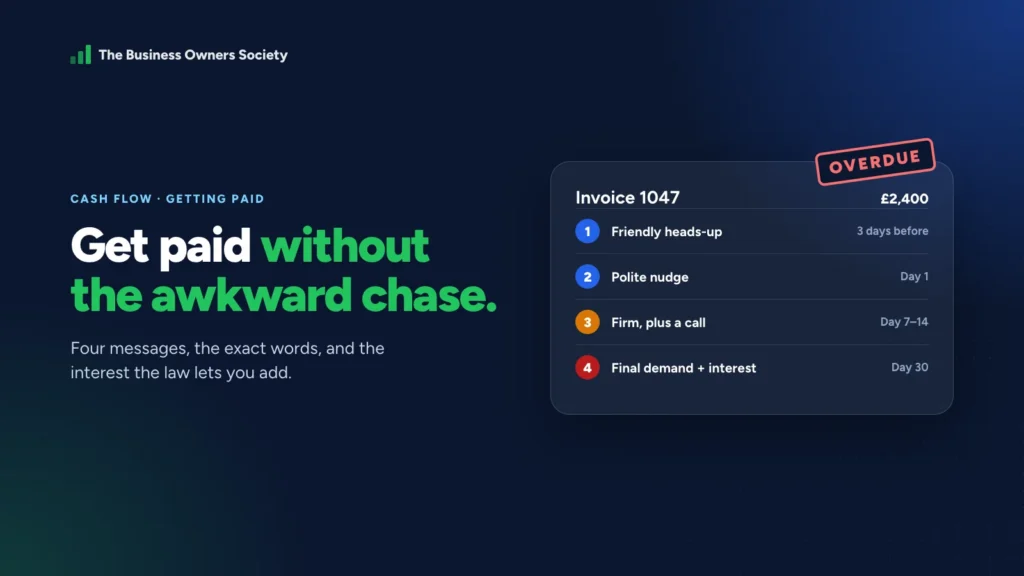
The four-step unpaid invoice chasing sequence
Each message has one job, and each one is a little firmer than the last. None of them is rude. You can be completely polite and completely persistent at the same time.
- 13 days before
Friendly heads-up
A reminder that it is due, with the invoice attached again.
- 2Day 1 overdue
Polite nudge
It is now due. Easy ways to pay, no blame.
- 3Day 7–14
Firm, and a phone call
A specific date, and you ring them as well.
- !Day 30
Final demand
Interest, compensation, and what happens next.
The step people skip is the phone call. It gets more invoices paid than any email.
1. Three days before it is due: the friendly heads-up
Subject: Invoice [number] due on [date]
Hi [Name], just a quick note that invoice [number] for [job], £[amount], is due on [date]. I’ve attached it again so it’s to hand. Bank details are on the invoice, or you can pay by card here: [link].
Thanks, [Your name]
This feels unnecessary, and it is the single most effective message in the sequence. It catches invoices that went to spam, sat in the wrong person’s inbox, or are waiting for a purchase order number nobody told you about.
2. The day after it is due: the polite nudge
Subject: Invoice [number] now due
Hi [Name], invoice [number] for £[amount] was due yesterday. If it’s already on its way, thank you, and please ignore this. If anything is holding it up, just let me know and I’ll sort it.
[Your name]
3. Seven to fourteen days overdue: firm, with a date and a call
Subject: Overdue: invoice [number]
Hi [Name], invoice [number] for £[amount] is now [X] days overdue. Please could you confirm when it will be paid? I’d be grateful for payment by [date, 7 days from now].
I’ll give you a ring on [day] in case it’s easier to sort over the phone.
[Your name]
Then actually ring. Ask a simple question: “Is there anything stopping this being paid?” You will find out in thirty seconds what a week of emails would not tell you: a missing PO number, a dispute about one line, or a cash-flow problem you can agree a plan for.
4. Thirty days overdue: the final demand
Subject: Final notice: invoice [number]
Dear [Name], invoice [number] for £[amount] was due on [date] and remains unpaid despite our reminders on [dates].
Under the Late Payment of Commercial Debts (Interest) Act 1998 we are entitled to statutory interest at 8% above the Bank of England base rate, currently £[daily amount] a day, and fixed compensation of £[40/70/100]. The total now due is £[total].
If payment is not received by [date, 7 days from now], we will begin formal recovery, which may include a claim through the courts, without further notice.
Yours sincerely, [Your name]
Only threaten what you are prepared to do. If you would never go to court over this amount, say you will “consider formal recovery” instead, and keep your credibility for the next one.
ChatGPT for Business Owners
50 copy-and-paste AI prompts for sales, marketing, customers, admin and money. Works with any AI tool.
Plan the chase for an invoice
Put in the invoice details and it dates every message for you. Copy each one into your diary or schedule it in your email.
Late payment interest and compensation calculator
If your customer is a business, the law lets you add interest and a fixed sum to a late invoice, even if your terms never mentioned it. It does not apply to invoices to consumers, where you can only charge interest if your contract says so.
£2,504.77total you can now claim
£34.77statutory interest so far
Plus £70 fixed compensation. Interest is adding about 77p a day.
| Invoice size | Fixed compensation |
|---|---|
| Up to £999.99 | £40 |
| £1,000 to £9,999.99 | £70 |
| £10,000 or more | £100 |
You can claim the fixed sum once per invoice, and you can also claim reasonable costs of recovering the debt. If you agreed a different interest rate in your contract, that rate applies instead of the statutory one. The rules are set out on gov.uk.
When is an invoice legally late?
- If you agreed a date, it is late the day after that date.
- If you agreed nothing, it is late 30 days after the customer received the invoice or you delivered the work, whichever is later.
- Business to business, payment terms should usually be no longer than 60 days, and 30 days for public authorities. Longer terms are allowed only if they are fair to both sides.
How to stop chasing in the first place
Gets paid
- Sent the day the job finishes
- Clear due date, not “30 days”
- Card or payment link on it
- Addressed to the person who pays
- Deposit or stage payments for bigger jobs
Waits
- Sent at the end of the month
- “Payment terms: 30 days”
- Bank details only, in small print
- Sent to whoever booked the job
- Whole amount at the end
- Invoice the same day. Every day you wait is a day added to when you get paid.
- Write a date, not a term. “Due 24 October” gets paid faster than “30 days from invoice”.
- Make paying one tap. A card payment link turns “I’ll do it later” into “done”.
- Take deposits and stage payments. For bigger jobs, never fund the customer’s work out of your own pocket.
- Put late payment terms on your invoice. A line saying you charge statutory interest on late business invoices changes behaviour, even if you rarely enforce it.
If they still will not pay
Letter before action
A formal letter giving them a final deadline, usually 14 days for a business and 30 days for an individual, before you start a claim.
Small claims
In England and Wales you can claim online through Money Claim Online. Small claims track covers most claims up to £10,000, and you do not need a solicitor.
Collection agency or solicitor
For larger debts or awkward customers. Weigh their fees against what you will recover.
Court procedures differ in Scotland and Northern Ireland. This is general guidance, not legal advice; for anything disputed or large, take advice before issuing a claim.
Your two jobs this week
Job 1: Chase everything overdue
Pull a list of every unpaid invoice past its due date. Send the right message from the sequence above to each one today, and ring the oldest three.
Job 2: Change your invoice template
Swap “30 days” for an actual date, add a card payment link, and add a line about statutory interest on late business invoices.
Members of the Society get jobs like these every week, with the tools to do them and somebody checking they got done. Start for £1 if you want somebody keeping count.
ChatGPT for Business Owners
50 copy-and-paste AI prompts for sales, marketing, customers, admin and money. Works with any AI tool.
Unpaid invoice questions owners ask
How do I politely chase an unpaid invoice?
Start before it is due with a friendly reminder, nudge the day after it falls due, then get firmer with a specific date and a phone call at one to two weeks. Keep every message short and factual, and always attach the invoice.
Can I charge interest on a late invoice?
On invoices to other businesses, yes: statutory interest at 8% above the Bank of England base rate, plus fixed compensation of £40, £70 or £100 depending on the amount. On invoices to consumers, only if your contract terms say so.
How long does a customer have to pay an invoice in the UK?
Whatever you agreed. If nothing was agreed, a business payment is late 30 days after the customer receives the invoice or the work is delivered, whichever is later.
What is a letter before action?
A formal letter giving the customer a final chance to pay by a set date before you start court proceedings. Courts expect you to send one before you issue a claim.
Can I stop work if a customer has not paid?
Check your contract first. Many trade contracts allow you to suspend work for non-payment with notice; without that, stopping can put you in breach. For construction work, the Construction Act has its own rules on payment and suspension.

James Nicholson
Founder of The Business Owners Society and Digital Marketing Desk. Built a £2m business from his bedroom, lost it, and spent the next fifteen years helping 150+ UK businesses get found.
More about James →