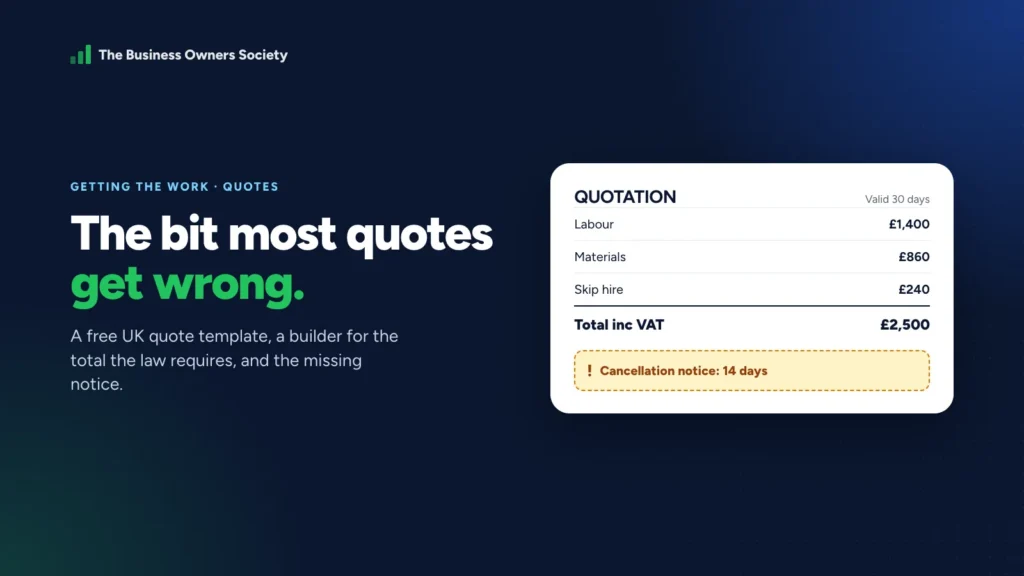
Search for a quote template and you get a hundred layouts. Almost none of them mention the three things UK law now actually requires on a quote to a consumer, and one of those three, left off, turns a 14-day cancellation right into something closer to a year.
So: a quote template you can use, a builder that works out the one figure the law insists on, and the part most trade quotes get wrong. England and Wales — Scotland and Northern Ireland differ on penalties.
What a quote to a consumer must contain
Since 6 April 2025, a written quote to a consumer is an “invitation to purchase” under the Digital Markets, Competition and Consumers Act 2024. That sounds like paperwork and is not: the Act lists information you must give, and omitting it is an offence rather than a bad look.
| Must appear | In practice |
|---|---|
| The total price of the job | One number, including VAT and every unavoidable charge. If part of it genuinely cannot be worked out in advance, you must say how that part will be calculated — with the same prominence as the headline figure |
| The main characteristics of the work | What you are actually going to do, in enough detail to be judged |
| Who you are | Your identity, and anyone you are acting on behalf of |
| Your business address, your service address if different, and your business email | A real address where documents can be served. Not just a mobile number |
| Any charges the customer may choose to incur that aren’t in the total | Optional extras and delivery, with a note if they can’t be calculated yet |
Two consequences worth sitting with.
A breakdown without a total is now prohibited. The CMA calls it partitioned pricing: listing labour, materials and VAT separately and leaving the customer to add it up is not providing the total price. A breakdown alongside a clearly stated total is explicitly fine — and is better anyway.
And so is adding mandatory charges later. Showing a headline figure and introducing unavoidable extras as the job proceeds — drip pricing — is prohibited. If a charge is unavoidable, it belongs in the total on the quote.
ChatGPT for Business Owners
50 copy-and-paste AI prompts for sales, marketing, customers, admin and money. Works with any AI tool.
Quote or estimate?
No statute defines either word, so be careful with anyone who tells you the law says X. The position, as the Trading Standards business guidance puts it, is that a quotation is normally a fixed price and an estimate is generally a rough guess of what the work will cost. A quotation usually amounts to an offer, and once the customer accepts it you probably have a binding contract at that price.
The practical rule that follows: if you call it a quote, expect to be held to it. If you genuinely cannot price it yet — you don’t know what’s behind the wall — then either call it an estimate and say so plainly, or quote the part you can price and state how the rest will be calculated. The second is better, and it is what the total-price rule above effectively asks for.
And ignore anybody who tells you there is a legal percentage by which an estimate may be exceeded. There isn’t one. Where no price and no pricing mechanism was agreed at all, the customer owes a reasonable price, and the law does not define reasonable.
Green: must appear. Amber: the one most quotes leave off.
The quote builder
Put your numbers in. It works out the figure you are required to show, and tells you which extra obligations your answers trigger.
That total is the number the law wants, and it is the only number a customer should have to read. Show the breakdown underneath it by all means — that is allowed and it wins jobs. Just never show the parts without the whole.
The bit most trade quotes get wrong
If you hand over a quote in the customer’s living room and they accept it there, that is an off-premises contract. The definition is a contract concluded in the simultaneous physical presence of trader and consumer, somewhere that isn’t your business premises. Which is most trade work in the country.
Three things follow, and most quote templates carry none of them.
They get 14 days to cancel, for any reason
For a service contract the cancellation period runs 14 days from the day after the contract is entered into. Not from when you start. Not from when you finish.
You must tell them, in writing, on paper or by email
The cancellation information is part of a list of pre-contract information you have to give on a durable medium, and it comes with a cancellation form the customer can use.
If you want to start inside the 14 days, you need their express request
And for an off-premises contract that request has to be on a durable medium — a signed line on the quote, or an email. Not a nod on the doorstep.
What it costs to leave the cancellation notice off. The cancellation period no longer ends after 14 days. If you supply the information late, it ends 14 days after they receive it — and if you never do, it ends 12 months after the date it would originally have expired. Entering into that contract without the required information is also a criminal offence under the regulations. And if you started work without a proper express request and the customer then cancels, the rules on what you can charge them do not work in your favour.
There is relief for genuine emergencies. Where the consumer specifically asked you to visit to carry out urgent repairs or maintenance, the cancellation rules do not apply to that work — but they do still apply to any additional services beyond the urgent repair, and to any goods other than the replacement parts necessarily used. So the boiler repair they rang you about at 7am is exempt; the new radiators you sell them while you are there are not.
There is also a lighter-touch route for small immediate jobs: where the consumer explicitly asked for repairs or maintenance, both sides are to perform immediately, and the payment is not more than £170, a reduced set of information applies rather than the full list.
Cancellation notice given
- Customer can cancel within 14 days
- Work can start sooner if they ask in writing
- They pay for work already done if they cancel
Cancellation notice missing
- The 14 days is extended by up to 12 months
- Work started early may not have to be paid for
- You may have to refund them even after the job is finished
Deposits
You can take one. There is no statutory cap and no rule against it. Three things to get right:
- Say so on the quote. If you require a deposit, the existence and the conditions of it are part of the information you must give.
- If they cancel inside the cancellation period, it goes back in full, and you cannot charge a fee for refunding it.
- Be careful with the word non-refundable. The CMA’s position is that making a substantial prepayment entirely non-refundable regardless of circumstances is more likely to be unfair. A genuine deposit that works as a binding reservation, disclosed early, with clear and narrow circumstances in which you’d keep it, is more likely to be fair — and the CMA notes a genuine deposit will not normally be more than a small percentage of the price. It puts no number on that, so neither will I.
Your details, and the difference between a sole trader and a company
| What has to be on your paperwork | |
|---|---|
| Sole trader | If you trade under anything other than your own surname with permitted additions — so “Dave Smith Plumbing” rather than “D Smith” — you must state your name and an address at which documents can be served on your invoices and receipts, and give it in writing on request. If you have a UK place of business, that address must be in the UK. |
| Limited company | Your registered name on invoices and demands for payment, and on your website. On business letters, order forms and your website also: the part of the UK you’re registered in, your company number, and your registered office address. |
If you are VAT registered, prices you quote to a consumer must include VAT. The CMA is explicit that a trader quoting someone they know to be a consumer must always include VAT in the total price — trade-only price lists excluding VAT are a different thing for a different audience.
How long should a quote be valid?
There is no legal requirement at all, and no statutory default. An offer lapses after a reasonable time, and the law does not say what reasonable is — which is exactly why putting a period on it helps you. Trading Standards guidance suggests you may wish to put a time frame on quotations, and that doing so shows what you consider reasonable.
Pick a number that suits your material prices and write it on. What you should not do is leave an open-ended “prices subject to change” clause floating about: a term letting you vary the price after acceptance is on the shaky side of the unfair terms rules.
ChatGPT for Business Owners
50 copy-and-paste AI prompts for sales, marketing, customers, admin and money. Works with any AI tool.
The template
Copy this, put your own details in, and keep the order. Everything in square brackets is yours to fill.
QUOTATION

[Your business name]
[Address where documents can be served]
[Email]   [Phone]
[Company number and registered office, if a limited company]
[VAT number, if registered]

Quote number: [ ]        Date: [ ]
Valid until: [ ]

For: [Customer name]
At:  [Job address]

THE WORK
[What you will do, in plain detail. What is included.]
[What is not included.]
[Who supplies what. Access and conditions you are assuming.]

PRICE
Labour                       [ ]
Materials                    [ ]
[Other unavoidable charges]  [ ]
VAT at 20%                   [ ]
-------------------------------------
TOTAL PRICE INCLUDING VAT    [ ]

[If any part cannot be priced yet, say exactly how it will be
calculated, as prominently as the total above.]

PAYMENT
Deposit of [ ] payable on acceptance. The deposit is
refundable in full if you cancel within the cancellation
period below.
Balance due [ ] days after completion.

TIMING
Expected start: [ ]      Expected duration: [ ]

YOUR RIGHT TO CANCEL
You have the right to cancel this contract within 14 days
without giving any reason. The cancellation period ends 14
days after the day this contract is entered into. To cancel,
tell us in a clear statement - by post or email using the
details above - or use the cancellation form attached. If you
cancel, we will refund all payments received from you without
undue delay.

STARTING WITHIN THE CANCELLATION PERIOD
If you want us to begin before the 14 days are up, please sign
below:
[ ] I expressly request that work begins during the
    cancellation period.
[ ] I understand that once the work has been fully performed
    I will lose my right to cancel, and that if I cancel part
    way through I must pay for what has been supplied.

Signed: ..............................  Date: ............

ACCEPTANCE
Signed: ..............................  Date: ............
Attach the statutory cancellation form alongside this for off-premises work. The wording above reflects the information the regulations require; it is a starting point, not a substitute for advice on your own contracts.
Your two jobs this week
1. Add the cancellation section to your quote. Once.
You write quotes on a template already. Paste the cancellation wording and the express-request box into it today and you never have to think about it again. This is the single highest-value ten minutes in this article, because it is the one omission with a twelve-month tail and a criminal offence attached.
2. Put one total, including VAT, at the bottom of every quote.
Not a column of components for the customer to add up. One figure, with the breakdown above it if you like. Then check nothing unavoidable is missing from it, because adding it later is now prohibited rather than merely irritating.
A clear quote is also the one that wins. The quote follow-up that actually gets an answer covers what to do after you have sent it, and working out what to charge per hour covers the number you put in the labour line. If you want the whole thing done in order with somebody checking, you can start for £1.
Quote questions owners ask
What has to be on a quote in the UK?
For a quote to a consumer: the total price including VAT and every unavoidable charge, the main characteristics of the work, who you are, your business address and service address if different, your business email, and any optional charges the customer may choose to incur. If you quote in the customer’s home you must also give the pre-contract information required by the Consumer Contracts Regulations 2013, including the right to cancel and a cancellation form. Sole traders trading under a business name and limited companies have additional details to show on invoices and letters.
What is the difference between a quote and an estimate?
No statute defines either word. Trading Standards guidance puts it as: a quotation is normally a fixed price, an estimate is generally a rough guess of what the work will cost. A quotation usually amounts to an offer, so once accepted you are likely to be bound at that price. If you cannot price the job properly, either say clearly it is an estimate or quote what you can and state how the rest will be calculated.
Can a customer cancel after accepting my quote?
If they accepted it in their own home with you present, yes — that is an off-premises contract and they have 14 days to cancel for any reason, running from the day after the contract was entered into. The exception is where they specifically asked you to visit to carry out urgent repairs or maintenance, which is outside the cancellation rules, though any extra work you sell on that visit is not.
What happens if I do not put the cancellation notice on my quote?
The cancellation period stops ending after 14 days. If you supply the information late it ends 14 days after the customer receives it, and if you never supply it, it ends 12 months after the date it would originally have expired. Entering into the contract without the required information is also a criminal offence under the regulations, and if you have started work without a proper express request the rules on what you can charge do not favour you.
Can I start work before the 14 days are up?
Yes, but you need the customer’s express request, and for an off-premises contract that request must be on a durable medium — signed on the quote, or by email. Get them to acknowledge that they lose the right to cancel once the work is fully performed. Without that, starting early is a risk you are carrying for nothing.
Can I take a non-refundable deposit?
You can take a deposit, and you must disclose it and its conditions on the quote. “Non-refundable” is riskier than it looks: the CMA’s view is that making a substantial prepayment entirely non-refundable regardless of circumstances is more likely to be unfair, while a genuine deposit operating as a binding reservation, disclosed early with clear and narrow conditions, is more likely to be fair. And if the customer cancels within the statutory cancellation period, it must be refunded in full with no fee.
Do I have to show VAT separately on a quote?
If you are VAT registered, the price you quote a consumer must include VAT, and the total must be shown as one figure. You may show the breakdown including the VAT element alongside it — that is permitted and clearer. What you must not do is show the components and leave the customer to total them up, or quote a VAT-exclusive figure to someone you know is a consumer.
How long is a quote valid for?
As long as you say it is. There is no legal requirement to state a period and no statutory default, but an offer lapses after a reasonable time and nobody defines reasonable — so stating your own period is the sensible move and Trading Standards guidance suggests doing it. Avoid an open-ended clause letting you change the price after acceptance; that is the sort of term the unfair terms rules exist for.
England and Wales, checked on 9 October 2026 against: the Consumer Contracts (Information, Cancellation and Additional Charges) Regulations 2013, in particular regulations 5, 10, 11, 19, 28, 30, 31, 34 and 36 and Schedule 2; the Digital Markets, Competition and Consumers Act 2024, section 230, in force 6 April 2025; the CMA’s guidance on price transparency (CMA209) and unfair contract terms (CMA37); the Trading Standards-backed Business Companion guidance on supplying services, contract law basics and off-premises sales; the Companies Act 2006 Part 41 Chapter 2; and the Company, Limited Liability Partnership and Business (Names and Trading Disclosures) Regulations 2015. Penalties and procedure differ in Scotland and Northern Ireland. This is general information, not legal advice, and it is not a substitute for having your own contract terms looked at.
ChatGPT for Business Owners
50 copy-and-paste AI prompts for sales, marketing, customers, admin and money. Works with any AI tool.
Primary sources: Consumer Contracts (Information, Cancellation and Additional Charges) Regulations 2013 · regulation 31, extended cancellation period · Schedule 2, pre-contract information · DMCC Act 2024 section 230 · CMA guidance on price transparency · Business Companion on supplying services · Business Companion on off-premises sales · Business Companion on forming a contract.

James Nicholson
Founder of The Business Owners Society and Digital Marketing Desk. Built a £2m business from his bedroom, lost it, and spent the next fifteen years helping 150+ UK businesses get found.
More about James →